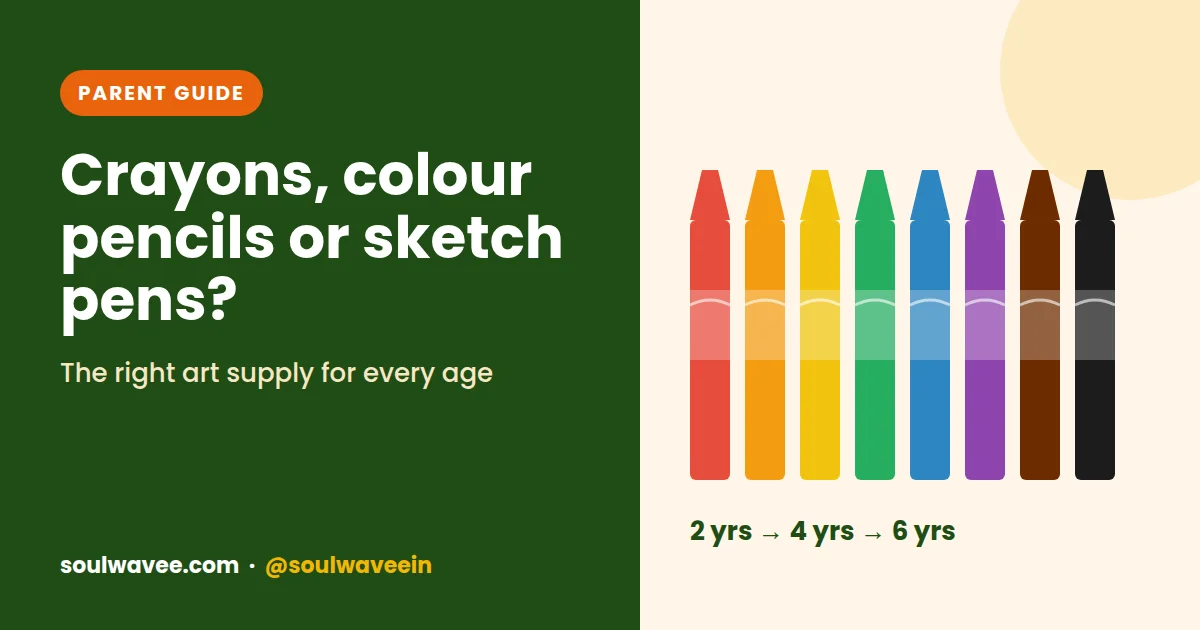
Crayons, Colour Pencils or Sketch Pens? The Right Art Supply for Every Age
Quick answer: Start toddlers (18 months to 3 years) with thick or short crayons, move to colour pencils once your child holds a crayon with fingers instead of a fist (usually around 4), and add sketch pens for bright colouring and school charts. Crayons build hand strength; pencils build control; sketch pens build confidence with bold colour.
Key takeaways by age
| Age | What most kids can do | Best art supply |
|---|---|---|
| 18 months | Scribble | Chunky wax or plastic crayons (supervised) |
| 3 years | Draw a circle when shown | Crayons, short crayons, tempera colours |
| 4 years | Hold a crayon between fingers and thumb; draw a person | Crayons + colour pencils |
| 5 years | Write some letters of their name | Colour pencils, sketch pens, water colours |
| 6+ years | Controlled tripod grip | 24-shade colour pencils, brush pens, acrylics |
Milestones from the US CDC; grip stages from occupational therapy guidance. Every child develops at their own pace.
How a child's grip develops
Occupational therapists describe a typical progression: a whole-hand fist grip at 12–18 months, a "digital pronate" grip (fingers pointing down) around 2–3 years, then a four-finger quadrupod grip, and finally the mature dynamic tripod grip – thumb, index and middle finger – somewhere between 4 and 7 years. Ages vary; what matters is steady progress.
Why crayons come first
Crayons need a little push to leave colour on paper. That resistance gives children pressure feedback and strengthens the small muscles of the hand – exactly the muscles needed for handwriting later. Occupational therapists even recommend breaking crayons into short pieces: a short crayon naturally encourages a finger grip instead of a fist.
When to switch to colour pencils
Once a child holds a crayon between the fingers and thumb (the CDC milestone for most 4-year-olds), colour pencils are a great next step. They allow finer detail and teach children to control pressure for light and dark shades. Choose sets with soft, bright leads so little hands don't have to press too hard.
Where sketch pens fit in
Sketch pens and water colour pens give bright, even colour with almost no pressure. That makes them wonderful for charts, cards and confidence – but they build less hand strength than crayons, so mix both. Washable, water-based pens are the easiest for young kids.
The colourful history of crayons
The first Crayola box came out in 1903 with 8 colours – red, orange, yellow, green, blue, violet, brown and black – and cost just 5 US cents. The name was coined by Alice Binney, a former schoolteacher, from the French craie (chalk) and "oleaginous" (oily). Today Crayola makes more than 3 billion crayons a year. In India, DOMS (roots in the 1970s) and Camlin (started in 1931 as an ink-powder business) are the names most of us grew up with.
How to read safety labels
- "Conforms to ASTM D-4236" only means the product was reviewed and labelled under a US law – it does not by itself mean non-toxic.
- ACMI "AP" seal certifies a product is safe for children (6th grade and younger).
- EN 71-3 is the European standard limiting heavy metals in toy materials.
- Always supervise toddlers – crayons and caps are small enough to go into mouths.
Our picks by age
- Toddlers: DOMS plastic crayons (14 or 28 shades) and wax crayons
- Pre-school: DOMS Extra Long wax crayons, play dough for finger strength
- Primary school: 12- or 24-shade colour pencils, water colour pens
- Older kids: brush pens, water colour tubes and acrylics
FAQs
What age can a child start using crayons?
Most children can scribble by about 18 months, so chunky crayons under supervision suit toddlers.
Crayons or colour pencils first?
Crayons first. Switch to colour pencils once your child holds a crayon with fingers rather than a fist – usually around age 4.
Are sketch pens good for toddlers?
Washable sketch pens are fine for older toddlers under supervision, but crayons build more hand strength, so use both.
Are "non-toxic" crayons really safe?
Look for recognised marks such as ACMI AP or EN 71. "Conforms to ASTM D-4236" alone only means the product was assessed and labelled.
Proud of your little artist? Share their masterpiece and tag @soulwaveein – we feature kids' art every week. Explore our full art & craft range.