Ball Pen vs Gel vs Roller vs Fountain: Which Pen Is Best for Exams?
Quick answer: For long board-exam answers, most students do best with a 0.5–0.7 mm ball pen – it dries fastest and smudges least, which also suits left-handers. A gel pen writes darker and smoother but needs a moment to dry. Roller (liquid-ink) pens glide with the least pressure, and fountain pens are for anyone who loves beautiful handwriting. Here's how each one works and which to pick.
Key takeaways
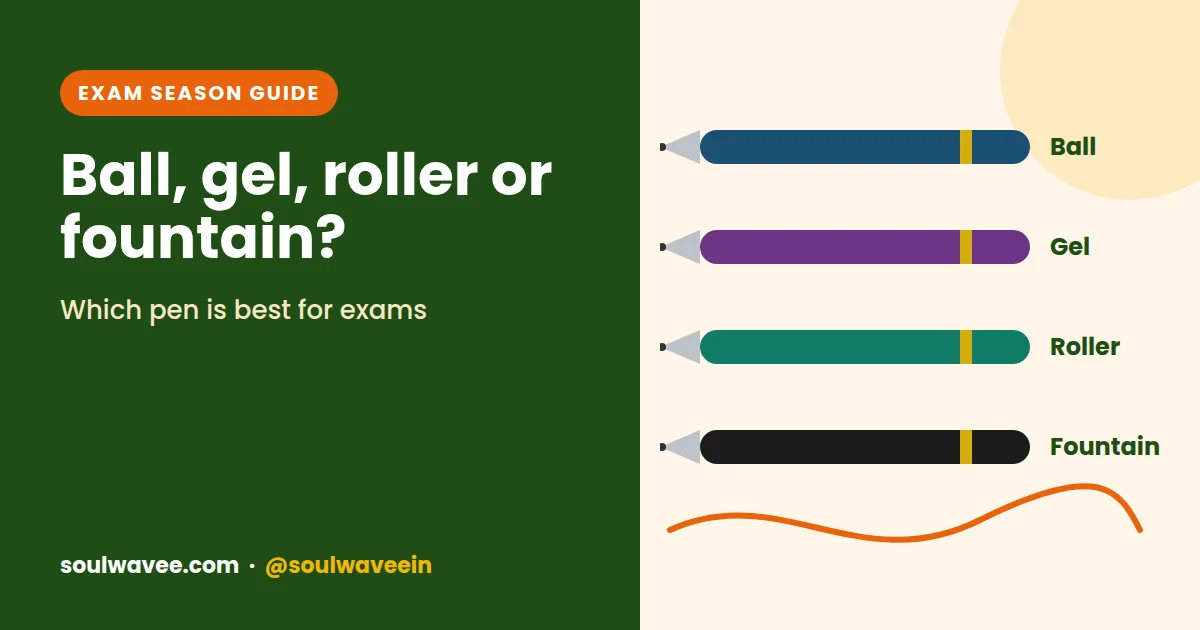
- Ball pen: thick oil-based ink, quick-drying, long-lasting, least smudging.
- Gel pen: pigment in a water-based gel, bold and smooth, slower to dry.
- Roller pen: thin water-based liquid ink, very smooth, uses ink faster, can bleed on thin paper.
- Fountain pen: ink flows through the nib by capillary action – a "controlled leak" that writes only when it touches paper.
- The number on a pen (0.5, 0.7 mm) is the tip size: smaller means a finer line.
How a ball pen works (and the journalist who invented it)
A ball pen has a tiny metal ball sitting in a socket. As it rolls, one side picks up thick ink from the refill and the other side lays it on paper. The first ballpoint patent went to American John J. Loud in 1888, but his pen was meant for leather and was too rough for letters.
The practical ballpoint came from László Bíró, a Hungarian newspaper editor. He noticed newspaper ink dried quickly without smudging but was too thick for fountain pens, so he paired a thicker ink with a ball tip. He filed a British patent in 1938, moved to Argentina and patented it there in 1943. To this day people in the UK and Australia call a ball pen a "biro", and Argentina celebrates Inventors' Day on his birthday, 29 September.
Fun fact: ball pens became popular with pilots because fountain pens leaked at high altitude.
Gel pens: the 1984 invention from Japan
Gel pens were introduced by Japan's Sakura Color Products in 1984. The ink is pigment suspended in a water-based gel, thickened with natural polymers such as xanthan gum. That's why gel writing looks so rich and dark. Gel ink also resists solvents, which is why police in some countries have advised writing cheques with gel pens to prevent "check washing".
Popular Indian gel pens include Cello Aqua, Flair Glass, Apsara Lit and Reynolds Racer.
Roller pens: liquid ink that glides
Japan's Ohto introduced the liquid-ink rollerball in 1963. Roller pens use thin, water-based ink that soaks into paper, so they need very little pressure – great for fast writers and long signing sessions. The trade-off is that they use ink faster and can bleed on thin paper. Classic examples are the Pilot Hi-Tecpoint V7 and uni-ball Eye.
Fountain pens: the oldest of the four
A fountain pen's feed lets ink flow down while air flows up, and capillary action carries ink through the slit in the nib. The earliest recorded reservoir pen was made for a Fatimid caliph in the 10th century. India has its own proud fountain-pen history: Ratnam Pen Works in Rajahmundry started making fully swadeshi pens in 1932, and Mahatma Gandhi wrote that the pen seemed "a good substitute to the foreign pen". Want to start? Try a beginner-friendly Parker Beta fountain pen.
India's favourite pen brands, in one paragraph
Almost every Indian student has owned a Reynolds 045 – for years it sold for about ₹6–7, and the 2023 "discontinued" posts turned out to be a rumour. Cello started making pens in 1995 and was India's largest writing-instrument maker when France's BIC bought it fully in 2015. Linc, founded in Kolkata in 1976 with a ₹2 pen, launched Pentonic in 2018 – by 2022 it was selling over 20 million units a month.
Which pen is best for exams?
There's no scientific study that crowns one winner, so here's practical guidance:
- Long answer sheets, fast writing, left-handers: a ball pen – it dries instantly and won't smudge under your hand.
- Neat, dark presentation: a gel pen, but pause before turning the page.
- Tired wrists: a roller pen needs the least pressure.
- Tip size: 0.5 mm for small, neat handwriting; 0.7 mm for smoother, bolder writing.
- Always carry spares – buy a pack of 5 or 10 of the same pen so your handwriting looks consistent.
FAQs
Who invented the ballpoint pen?
John J. Loud patented the first ballpoint in 1888, but László Bíró created the practical modern version (patented 1938, and in Argentina in 1943).
What is the difference between a gel pen and a ball pen?
A ball pen uses thick oil-based ink that dries fast. A gel pen uses pigment in a water-based gel, which writes darker and smoother but takes longer to dry.
What does 0.7 mm on a pen mean?
It's the tip size. 0.5 mm writes a finer line; 0.7 mm writes a slightly bolder, smoother line. Actual line width varies by ink and brand.
Which pen is best for board exams?
Many students prefer a 0.5–0.7 mm ball pen because it dries fastest and smudges least; a quick-drying gel pen is a good alternative for darker writing.
Team gel or team ball pen? Vote on our Instagram poll at @soulwaveein. Shop all pens in packs of 1 to 12 – perfect for exam season.